Level 2 EV Charger Installation in Dallas
Searching for Level 2 EV charger installation in Dallas, TX (75247)? High Power Electrical Services installs home and workplace EV chargers the right way, with the correct circuit, breaker, and city permit so your car charges fast, safe, and to code, the first time.
Quick Answer
A Level 2 EV charger needs a dedicated 240-volt circuit, a properly sized breaker, and in most cases a permit from the City of Dallas. A licensed electrician confirms your panel has the spare capacity, runs the right gauge wire, mounts the unit, and tests it under load. Most Dallas home installs are completed in a single visit.
Home EV charging that is fast, safe, and built for Texas
An electric vehicle changes how you think about fuel. Instead of stopping at a station, you plug in at home and wake up to a full battery. The catch is that a standard wall outlet, called Level 1, trickles in only a few miles of range per hour. A Level 2 charger runs on a 240-volt circuit, the same kind that powers an electric dryer or range, and adds roughly 25 to 40 miles of range per hour. For most Dallas drivers that means a full overnight charge with room to spare.
Getting there safely is where a licensed electrician matters. A Level 2 install is not a plug-and-play project. It draws serious current on a continuous load, so the circuit, the breaker, the wire gauge, and the connection at your panel all have to be sized correctly. Done wrong, an EV circuit can overheat, trip constantly, or worse. Done right, it disappears into the background and just works for years.
High Power Electrical Services installs Level 2 chargers for every major EV brand across Dallas, from Tesla and Ford to Rivian, Hyundai, and beyond. We handle hardwired units and NEMA 14-50 outlet installs, pull the city permit when required, and coordinate with your panel so your charger never competes with your air conditioning on a hot Texas afternoon.
We also think past the first charge. The right install accounts for where you actually park, leaves tidy cable management, and labels the new circuit clearly in your panel. If you might add a second EV later, we can plan the capacity now so the upgrade is simple instead of a second project from scratch.
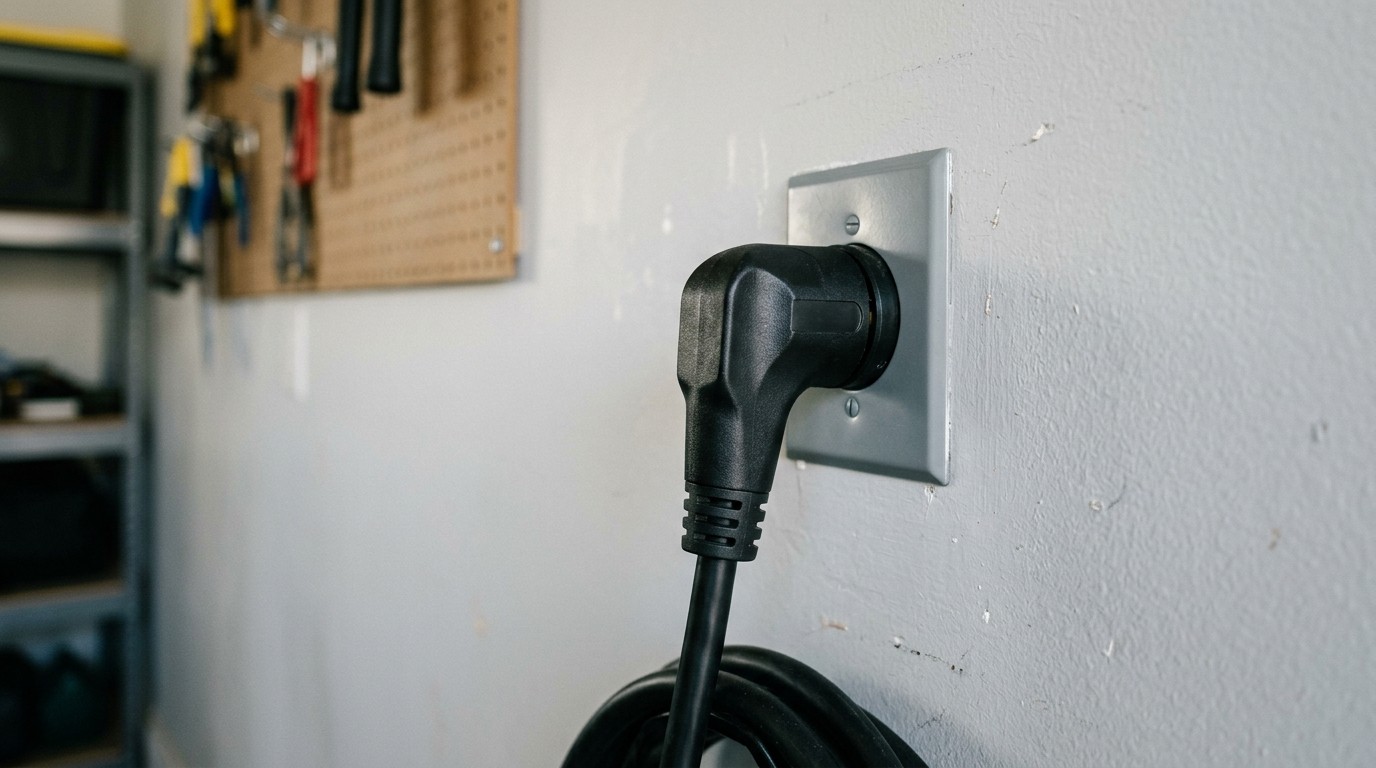
A dedicated 240-volt circuit is the heart of a safe Level 2 EV charger install.
Signs your EV setup needs a licensed electrician
If any of these sound familiar, do not keep charging on a makeshift setup. Call before a small problem becomes a hazard.
Charging on an extension cord
Running a charger through an extension cord or shared outlet is a fire risk and voids most charger warranties.
Warm or discolored outlet
A plug or outlet that feels hot, smells faintly of plastic, or shows browning is overloaded and unsafe.
Breaker trips while charging
A circuit that trips mid-charge is undersized for a continuous EV load and needs a proper dedicated circuit.
Slow charging on a 120V outlet
If your car barely gains range overnight, you are on Level 1 and a Level 2 circuit will transform the experience.
Old or full electrical panel
Many older Dallas homes have 100-amp panels with no spare slots, so a load calculation is essential before install.
A handyman wired it
Unpermitted DIY EV circuits often fail inspection and can complicate a future home sale or insurance claim.
Why a professional Level 2 install pays off
A charger you can trust is worth more than the few dollars saved by cutting corners. Here is what you gain.
Faster charging
Add 25 to 40 miles of range per hour instead of trickling on a wall outlet.
Real safety
Correct wire gauge and breaker sizing for a continuous high-current load.
Code and permits
Installed to NEC and Dallas code, with the permit and inspection handled.
Smart charging ready
WiFi-enabled units let you schedule charging for cheaper overnight rates.
Lower energy cost
Schedule charging during off-peak hours to cut what you pay per mile.
Any EV, any brand
Hardwired or NEMA 14-50, sized for your specific vehicle and panel.
Protects your home
A dedicated circuit keeps EV load off shared kitchen and laundry lines.
Future proof
Right-sized for today and ready if you add a second EV down the road.
Ready to charge at home in one visit?
Most Dallas Level 2 installs are done same day. Tell us your EV and your panel, and we will give you an honest quote.
(469) 327-8678How a Level 2 EV charger install actually works
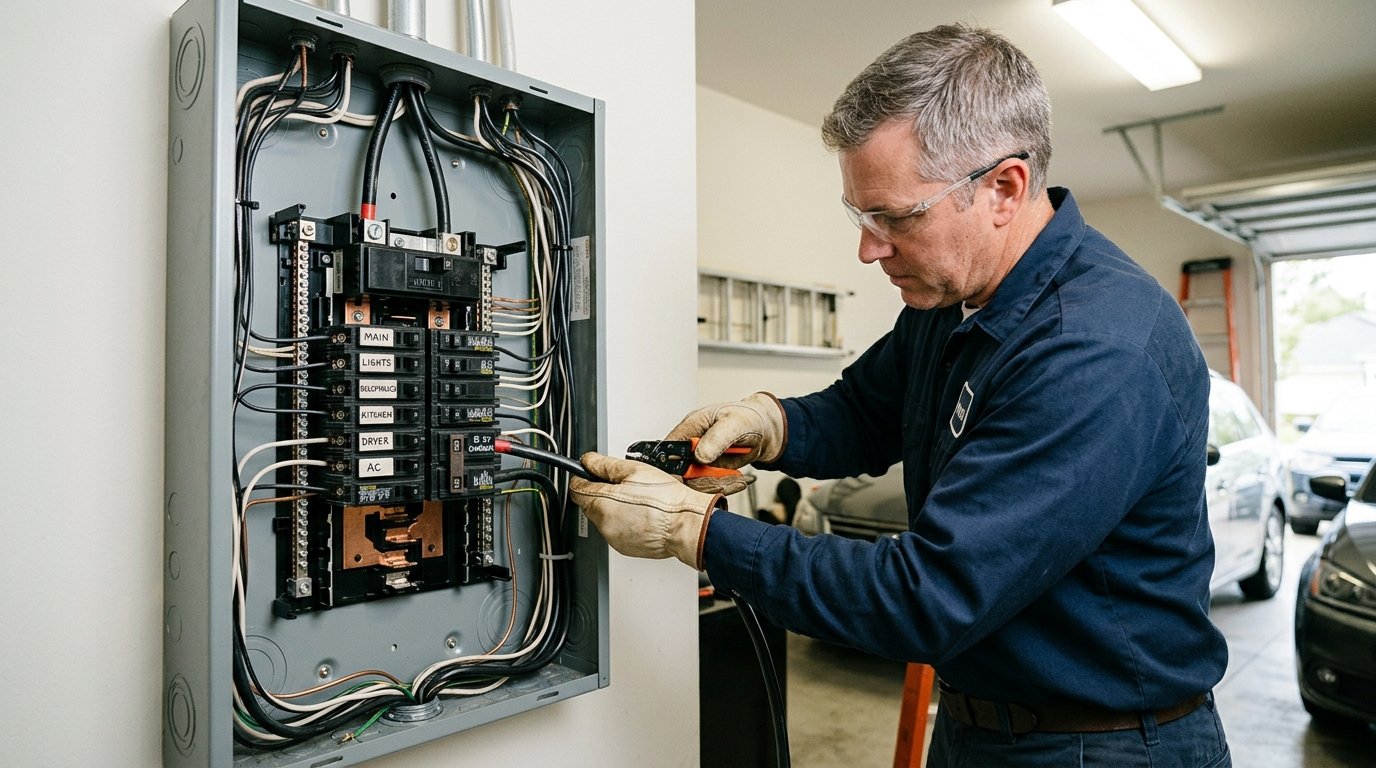
Every safe install starts with a load calculation. Your electrical panel has a fixed capacity, often 100, 150, or 200 amps, and an EV charger is one of the largest continuous loads you can add to a home. We measure your existing demand, factor in the air conditioning that runs hard through a Dallas summer, and confirm there is headroom for a 240-volt charging circuit. If the panel is full or undersized, we will tell you straight and lay out your options, which may include a panel upgrade or a load management device.
Next comes the circuit. A Level 2 charger typically needs a 40 to 60 amp double-pole breaker feeding a dedicated circuit. We route the correct gauge copper wire from your panel to the charger location, whether that is an attached garage, a carport, or an exterior wall. Distance matters here. A longer run may need a heavier wire to avoid voltage drop, which is exactly the kind of detail a licensed electrician gets right and a quick install gets wrong.
Then we mount and connect the unit. Hardwired chargers attach directly to the circuit for a clean, permanent install, while a NEMA 14-50 outlet gives you the flexibility to unplug a portable charger. We mount the equipment at a comfortable height, secure the cable management, and make sure the charger sits where you actually park. Finally we energize the circuit, test it under load, verify the charger communicates with your vehicle, and walk you through scheduling and app setup before we leave.
Choosing the right charger and amperage
Not every charger needs to be the biggest one available. The right amperage depends on your vehicle, how many miles you drive a day, and your panel capacity. A 32-amp charger fully recharges most daily driving overnight, while a 48-amp unit makes sense for long commutes, larger battery trucks and SUVs, or a household that shares one car between two drivers. We match the charger to your real routine instead of overselling capacity you will never use.
The hardwired versus outlet choice matters too. A NEMA 14-50 outlet is flexible and lets you take a portable charger with you, but a hardwired unit supports the highest amperages and gives the cleanest, most permanent result. Both are code-compliant when installed correctly, and we help you weigh the tradeoffs for your garage and your car.
Finally, consider smart features. Many Level 2 chargers connect to WiFi so you can schedule charging for off-peak hours, track energy use, and avoid running the charger during the hottest part of a Texas afternoon when your AC is already working hard. We set up scheduling during the handoff so you start saving from the first charge.
Level 2 EV charger installation
Every High Power EV charger install is a complete, code-compliant job, not just a unit bolted to the wall.
- Free on-site assessment and panel load calculation
- Permit application with the City of Dallas when required
- Dedicated 240-volt circuit sized for your charger
- Correctly rated double-pole breaker installed in your panel
- Proper copper wire gauge for the run length
- Hardwired connection or NEMA 14-50 outlet, your choice
- Secure wall mounting and tidy cable management
- GFCI protection where code requires it
- Full load testing and vehicle communication check
- Walkthrough of app, scheduling, and safe use
DIY versus a licensed EV charger install
EV charger kits look simple online, but a 240-volt continuous circuit is not a weekend project. Here is the honest comparison.
DIY or unlicensed
- Easy to undersize the wire or breaker for the load
- No permit, which can fail a future home inspection
- Voltage drop on long runs damages the charger over time
- Mistakes on 240 volts are dangerous and can start fires
- Manufacturer warranty often voided by unpermitted work
- No load calculation, so the panel may be overloaded
Licensed electrician
- Wire and breaker sized correctly for continuous load
- Permit pulled and inspection passed in your name
- Voltage drop calculated for your exact run length
- Work performed and tested to NEC and Dallas code
- Install protects your charger and home warranty
- Full panel load calculation before anything is wired
What affects the cost of an EV charger install
Pricing depends on your home, not a one-size number. These are the factors that move an EV install up or down.
Distance from the panel
A short run to an attached garage costs less than a long run to a detached carport or far wall.
Panel capacity
If your panel is full or undersized, you may need a subpanel or upgrade to add the circuit safely.
Hardwired or outlet
A NEMA 14-50 outlet and a hardwired connection differ in parts and labor.
Wall and routing type
Running conduit through finished drywall, brick, or an attic adds labor versus an open garage wall.
Permit and inspection
City permit fees and the inspection visit are part of a fully compliant install.
Charger amperage
A 48-amp charger needs heavier wire and a larger breaker than a 32-amp unit.
These are general planning ranges for the Dallas area, not a quote. Every job is different, so we give you a free on-site assessment and an honest written price before any work starts.
Our EV charger installation process
From your first call to your first charge, here is exactly how we handle it.
Free assessment
We review your EV, your panel, and the charger location, then run a load calculation.
Honest quote
You get a clear written price covering parts, labor, permit, and testing before we start.
Permit handled
We file the City of Dallas permit so the install is documented and inspection-ready.
Circuit run
We install the breaker and route the correct gauge wire from the panel to your charger.
Mount and connect
We mount the unit, connect it hardwired or to a NEMA 14-50, and tidy the cable.
Load test
We energize and test under load, confirming the charger and your car communicate.
Walkthrough
We set up your charging schedule and app, then answer every question before we go.
How long it takes and what to expect
Most residential Level 2 EV charger installs in Dallas are completed in a single visit, often in three to five hours. A clean run to an attached garage with a panel that has spare capacity is the fastest scenario. Jobs that involve a long wire run, a panel upgrade, or a detached structure take longer, and we will tell you the realistic timeline up front so there are no surprises.
On the day of the install, you do not need to do much. We protect your floors, keep the work area clean, and shut off power only for the time it takes to land the new circuit in your panel. Before we leave, the charger is live, tested with your vehicle, and labeled in the panel. If a city inspection is scheduled, we coordinate it and make sure the work passes.
EV charging in Dallas: what local drivers should know
Dallas is one of the fastest-growing EV markets in Texas, and home charging is the single biggest reason owners stay happy with their cars. Most of the metro is served by Oncor, and a properly permitted Level 2 circuit keeps you on the right side of utility and code requirements. If you ever sell your home, a documented, inspected EV circuit is a selling point rather than a question mark for the buyer.
Texas heat is the other local factor that a good electrician plans around. Long summer afternoons mean your air conditioner is pulling hard at the same time your car wants to charge. That is why a load calculation matters and why a smart, schedulable charger is worth considering. Setting your EV to charge overnight keeps the load off the grid during peak hours, often saves money, and avoids stressing an older panel during the hottest part of the day.
We install across the city, from Downtown high-rise parking and Uptown townhomes to single-family homes in Lakewood, Preston Hollow, Oak Cliff, and Lake Highlands. Older neighborhoods sometimes have 100-amp service that needs attention before adding a charger, while newer construction often has the capacity ready to go. Either way, we assess your specific home and recommend the safest path, never a cookie-cutter install.
Apartment owners and small businesses are adding chargers too, whether for a single reserved space or a small bank of workplace stations. We handle those projects with the same care, sizing the service, planning the conduit runs, and coordinating permits so the installation is clean, safe, and ready to expand later.
The licensed Dallas team homeowners trust
Licensed pros
Texas TECL #38291 electricians on every EV install, never subcontracted guesswork.
Upfront pricing
A written quote covering parts, permit, and labor before we touch your panel.
Code-first
Every circuit sized and inspected to NEC and Dallas requirements.
We answer 24/7
Real people on the phone, with fast scheduling for your install.
EV charger installation FAQs
Often yes, but it depends on your panel size and existing loads. Many Dallas homes have 100 to 200 amp service. We run a load calculation to confirm there is spare capacity. If the panel is full, we can add a subpanel, install a load management device, or upgrade the panel so the charger runs safely.
In most cases yes. A 240-volt EV charging circuit is a permitted electrical job in the City of Dallas. We handle the permit application and the inspection as part of the install so the work is documented and compliant, which also protects you when you sell the home.
Both are good options. A hardwired unit is clean, permanent, and supports the highest amperages. A NEMA 14-50 outlet lets you unplug a portable charger and take it with you. We help you choose based on your charger, your amperage needs, and how you want to use it.
Most home Level 2 chargers add roughly 25 to 40 miles of range per hour, depending on the charger amperage and your vehicle. That is enough to fully charge most EVs overnight, compared to a standard wall outlet that adds only a few miles per hour.
A typical Dallas home install takes about three to five hours when the panel has capacity and the run is straightforward. Longer wire runs, panel upgrades, or detached garages add time. We give you a realistic timeline during the free assessment.
Yes. We install Level 2 chargers for Tesla, Ford, Rivian, Hyundai, Kia, Chevrolet, and every other major brand. We also install universal chargers that work across brands with the right adapter or connector.
Charging at home does add to your bill, but it is usually far cheaper per mile than gasoline. Scheduling your charge for overnight off-peak hours, which most smart chargers support, keeps the cost low and eases the load on your panel during hot afternoons.
We see this often in older Dallas homes. The fix may be a subpanel, a smart load management device that shares capacity, or a service upgrade to 200 amps. We explain each option and price it clearly so you can choose what fits your budget and plans.
No. Extension cords are not rated for the continuous high current an EV draws and are a real fire risk. They also void most charger warranties. If you are charging this way now, call us and we will get a proper dedicated circuit installed quickly.
Yes. Detached structures are common in Dallas and simply require a longer, properly sized run, sometimes with a small subpanel. We calculate the wire gauge for the distance to avoid voltage drop and keep the charge fast and safe.
They can. A WiFi-connected charger lets you schedule charging for off-peak overnight hours and track your energy use. Combined with shifting load away from hot afternoons, that usually lowers your cost per mile and eases strain on your panel.
Yes. We provide a free on-site assessment for EV charger installs across Dallas, including a panel load calculation, so you get an accurate written quote before any work begins.