EV Charger Installation Cost in Dallas: A Homeowner's Guide
What a Level 2 home charger really costs to install, what moves the price, and how to do it right the first time.
Quick Answer
A straightforward Level 2 charger install, where your panel is nearby and has spare capacity, is often a few hundred dollars of labor and materials on top of the charger. Longer wire runs, a panel or service upgrade, trenching to a detached garage, or limited capacity can push the total into the low thousands. The only accurate number comes from a free on-site assessment and a written quote, because every home is different.
Home EV charging, and where the cost really goes
Charging an electric vehicle at home is the single biggest convenience of owning one, and most Dallas drivers want a Level 2 charger to do it. A Level 2 unit runs on a 240-volt circuit, the same kind that powers an electric dryer or range, and it adds roughly ten times the range per hour that a standard 120-volt outlet does, enough to fully recharge most vehicles overnight.
The charger itself is only part of the story, and often the smaller part. What drives the cost and the quality of an EV charger installation is the electrical work behind it: the circuit that feeds the charger, the distance from your panel, and whether your panel has the capacity to carry a major new load at all. Done right, a home install is safe, fast-charging, and trouble-free for years. Done poorly, it trips breakers, charges slowly, or worse.
This guide walks through what an EV charger really costs to install in Dallas, the factors that move the price up or down, the all-important panel question, and how to get it done right the first time so you are not paying twice.
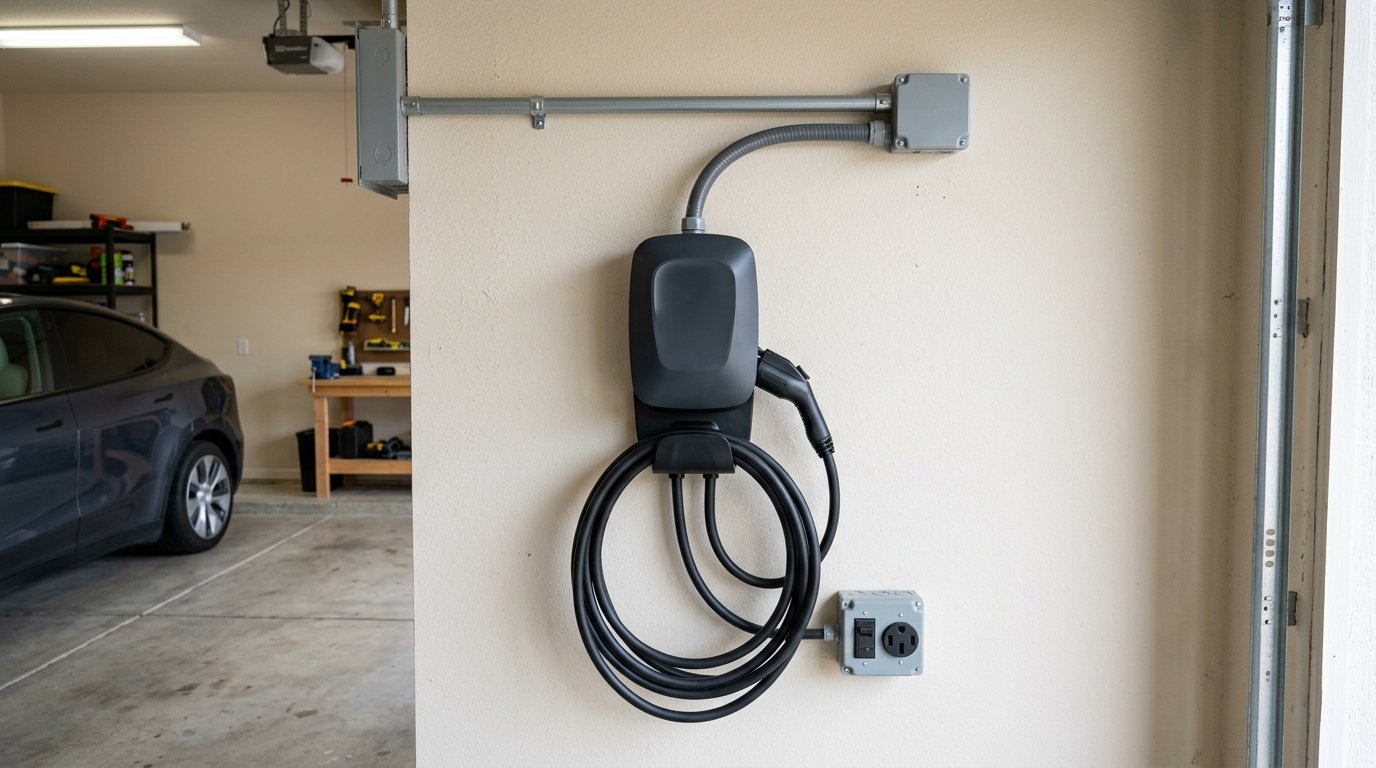
Most of the cost and quality of an EV install is in the circuit and panel work behind the charger.
What an EV charger installation costs
Six factors decide where your install lands on the price range.
Distance from the panel
The longer the run of cable from your panel to the charger, the more wire, conduit, and labor it takes. A charger near the panel is the cheapest install.
Panel capacity
If your panel cannot support a major new load, you may need a panel upgrade or a subpanel. This is the single largest factor and is common in older homes.
The charger you choose
Hardwired or plug-in, basic or smart and WiFi-connected, the unit you pick affects both hardware cost and installation.
Trenching or a detached garage
Running power to a detached garage or across a yard means trenching and longer runs, which adds meaningfully to the total.
Your electrical service size
A small or older service may need upgrading to add an EV charger safely, especially alongside central air and other large loads.
Permit and inspection
A proper EV install is permitted and inspected in Dallas. It is a small, worthwhile cost that protects safety and your home's value.
These are general planning ranges for the Dallas area, not a quote. Every job is different, so we give you a free on-site assessment and an honest written price before any work starts.
Level 1, Level 2, and the panel question
Every EV comes with a Level 1 cord that plugs into a standard 120-volt outlet, and it works, but slowly, adding only a few miles of range per hour. For most households that is not enough to keep up with daily driving, which is why a Level 2 charger on a dedicated 240-volt circuit is the standard choice. It charges roughly ten times faster and tops off most vehicles overnight.
Here is the part many homeowners do not expect: the make-or-break factor is rarely the charger and almost always the panel. A Level 2 charger is a large, continuous load, and code requires the circuit to be sized to a safe margin above the charger's draw. Before installing anything, a licensed electrician runs a load calculation to confirm your panel can actually carry that load on top of everything else your home runs.
When the panel has room, the install is straightforward. When it does not, which is common in homes with older or smaller service, the answer is a panel upgrade or an added subpanel. That is what protects you from the most common EV mistake: a charger that trips breakers or charges at reduced speed because the home could not support it.
Thinking about a home EV charger?
We give you a free assessment, confirm your panel can handle it, and an honest written quote, no guesswork.
(469) 327-8678How to do it right the first time
Doing an EV install right starts with hiring a licensed electrician and pulling a permit, not because of red tape, but because a 240-volt continuous load deserves it. The circuit must be sized correctly, the breaker and wire matched to the charger, the connections torqued to spec, and the work inspected. These are exactly the details that prevent the nuisance trips, slow charging, and overheating that plague rushed installs.
It also pays to think ahead. If you may add a second EV, a battery, or solar later, sizing the circuit and panel with a little headroom now saves a far larger bill down the road. We often recommend confirming panel capacity for where you are heading, not just where you are today, and a home battery pairs naturally with EV charging for homeowners who want it.
Finally, placement and charger choice matter. We help you position the charger for the easiest cable reach to your parking spot, and we advise on hardwired versus plug-in and on smart features, so you buy the right unit rather than the most expensive one. The goal is an install that simply works, every night, for years.
Can you install an EV charger yourself?
You can plan the project. The electrical is licensed work for a reason.
DIY or unlicensed
- Buy the charger and choose where it goes
- Decide on hardwired versus a plug-in unit
- Plan ahead for a second EV, battery, or solar
- Clear the garage wall and access for the work
Licensed electrician
- Run a load calculation to confirm panel capacity
- Size the circuit and breaker correctly for a continuous load
- Install the 240-volt circuit, charger, and any panel upgrade to code
- Pull the permit and pass inspection
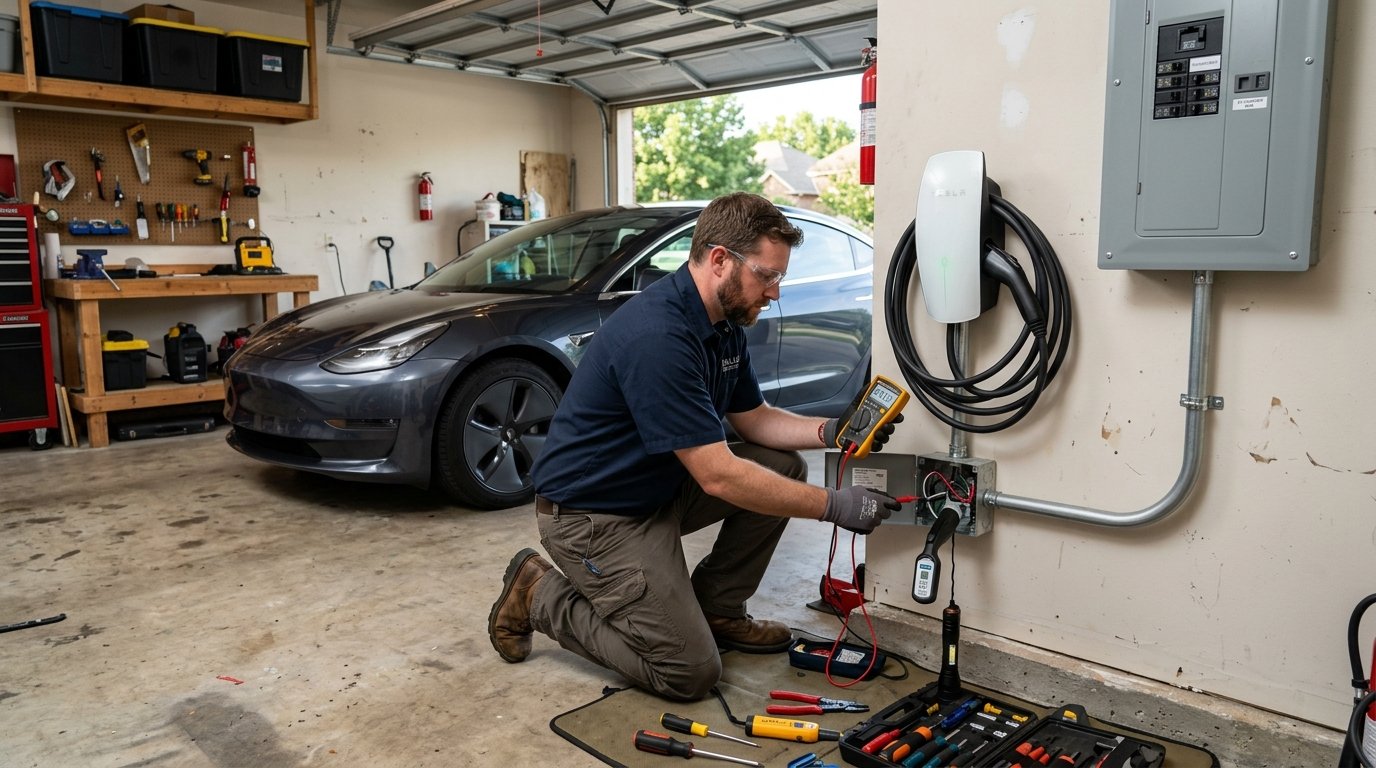
A proper install is load-calculated, permitted, inspected, and tested before you plug in.
EV charging in Dallas: what to know locally
Dallas adds a few local wrinkles to an EV install. The first is the city's older housing stock. Many homes in established neighborhoods, from North Dallas to the mid-century areas, have panels that were never sized for a modern EV charger on top of central air and today's electronics, so a panel upgrade is often part of the project. We always check capacity before promising a price.
The second is the heat. A Texas summer means your air conditioning is already a heavy, near-constant load, which makes the load calculation, and confirming your panel can carry the charger too, genuinely important rather than a formality. Getting this right is what keeps your charger and your AC running together without tripping.
Permitting and the local utility are the third. A proper EV install in Dallas is permitted and inspected, and larger jobs may involve coordinating with the utility on the service. We handle the permit and the process so you do not have to, and we can advise on any current incentives without overpromising, since rebate programs change. Whatever your neighborhood, we size and install the charger for how you actually drive.
Our EV charger installation process
A clear path from your first call to charging at home.
Assess and load-calc
We look at your panel, parking, and driving, and run a load calculation to confirm what your home can support.
Clear written quote
You get an honest, itemized price, including any panel work, before anything begins, with no surprises.
Install and permit
We install the circuit, charger, and any upgrade to code, pull the permit, and arrange inspection.
Test and show you
We test the charger under load, confirm full-speed charging, and walk you through using it.
EV charger installation FAQs
A straightforward Level 2 install, where the panel is nearby and has spare capacity, is often a few hundred dollars of labor and materials on top of the charger. Longer runs, a panel or service upgrade, or trenching to a detached garage can take the total into the low thousands. Because every home differs, we give a free assessment and a written quote rather than a one-size number.
Sometimes. A Level 2 charger is a large continuous load, and if your panel cannot safely carry it on top of your other loads, you will need a panel upgrade or a subpanel. This is common in older homes. We run a load calculation first and tell you honestly whether it is needed.
Both are valid. Plug-in units on a dedicated outlet are flexible and easy to replace, while hardwired units are often preferred for higher-power chargers and outdoor or permanent installs. We help you choose based on your charger, location, and how you will use it.
For most homes a Level 2 charger rated for the speed your vehicle can accept is plenty, and smart, WiFi-connected models add scheduling and energy tracking. We can advise on a unit that fits your car, your panel, and your budget, so you do not overbuy.
You can choose the charger and where it goes, but the 240-volt circuit, breaker, panel work, and the load calculation are licensed work for good reason, given the continuous load and the shock and fire risks. A proper install is also permitted and inspected. We recommend leaving the electrical to a pro.
A simple install where the panel has capacity is often done in a few hours. If a panel upgrade, a long run, or trenching is involved, it can take longer or span more than one visit. We give you a realistic timeline with your quote.
Yes, a proper installation is permitted and inspected, which protects your safety and your home's value. We handle the permit and inspection as part of the job, so you do not have to manage the process.
Often yes, but it depends on your panel and service capacity rather than your outlets. Older homes frequently need a panel upgrade to add a charger safely. We assess your specific home and recommend the right approach honestly.
A Level 2 charger adds roughly ten times the range per hour of a standard outlet, enough to fully recharge most electric vehicles overnight. The exact speed depends on your charger's rating and how much charging your vehicle can accept.