Commercial Parking Lot Lighting Repair in Dallas
Need parking lot lighting repair in Dallas, TX (75247)? High Power Electrical Services repairs and retrofits commercial pole lights, fixtures, photocells, and underground feeders, and converts aging lots to efficient LED, so your property stays safe, bright, and compliant.
Quick Answer
Dark or failing parking lot lighting is a safety and liability problem for any commercial property. We diagnose and repair pole lights, fixtures, photocells, and underground feeders, replace knocked-down poles, and retrofit aging lots to efficient LED. With bucket-truck access and licensed electricians, we keep your lot bright, reliable, and compliant.
Reliable lot lighting protects your property and your customers
A well-lit parking lot is not a nicety for a commercial property, it is a safety and liability essential. Dark or burned-out lot lighting raises the risk of trips and falls, makes a property a more inviting target after dark, hurts how customers and tenants perceive the business, and can run afoul of lease terms or local lighting requirements. Keeping the lot lit is part of protecting the property and the people who use it.
Lot lighting fails in a handful of common ways. Individual fixtures burn out or flicker, an aging photocell gets stuck so lights stay on through the day or never come on at night, a whole bank goes dark from a feeder or breaker issue, an underground fault kills a pole, or a pole gets knocked down. Older lots running metal halide or high-pressure sodium lamps also dim and yellow with age and grow expensive to keep relamping.
We diagnose and repair all of it. Because the problem could be the fixture, the control, or the wiring feeding the pole, we troubleshoot systematically rather than just swapping lamps, and our bucket-truck access lets us safely reach high pole-mounted fixtures. From a single dark fixture to a lot-wide outage, we find the cause and fix it.
We also handle the upgrade that pays for itself over time: converting aging, inefficient lighting to LED. An LED retrofit cuts energy use, lasts far longer with less maintenance, and delivers brighter, whiter, more uniform light. For property managers tired of recurring lamp and ballast failures, it often makes more sense than repairing old fixtures again.
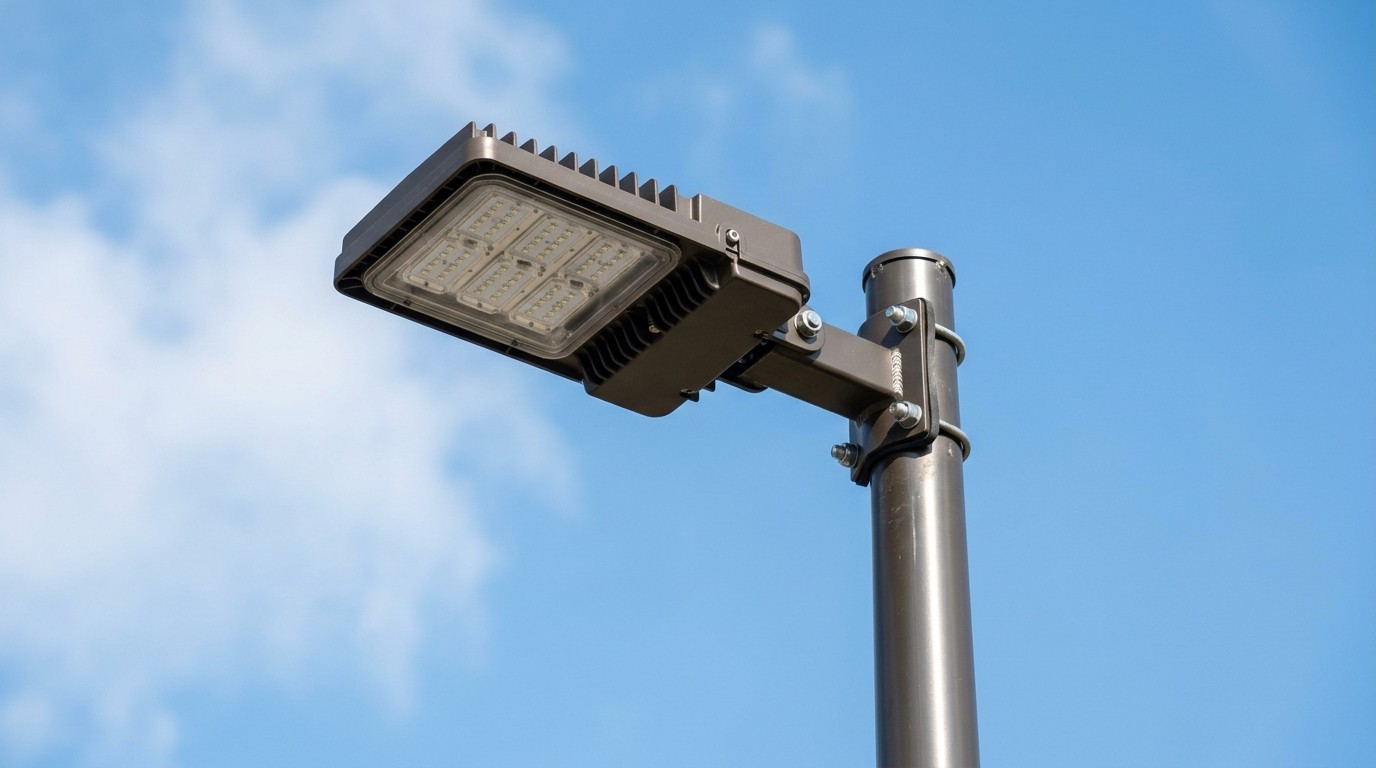
Modern LED area fixtures deliver brighter, more uniform light with less maintenance.
When your lot lighting needs service
If your property has any of these, prompt repair protects safety and limits liability.
Dark areas in the lot
Burned-out fixtures leave dark zones that raise safety and liability concerns.
Photocell stuck
Lights on during the day or off at night usually mean a failed photocell or control.
A whole bank is out
Multiple lights out together points to a feeder, breaker, or control problem.
Knocked-down or leaning pole
A pole hit by a vehicle or storm is a hazard that needs prompt, safe repair.
Dim, yellow, or flickering
Aging metal halide or sodium lamps dim and flicker and are costly to keep relamping.
High lighting bills
Inefficient old fixtures and constant relamping make a strong case for an LED retrofit.
Why professional lot lighting service matters
Reliable, efficient lot lighting protects the property and the budget. Here is what you gain.
Reduced liability
A well-lit lot lowers slip, fall, and security risks.
Bright, even light
Proper repair and aiming eliminate dark spots.
Energy savings
LED retrofits cut lighting energy use significantly.
Less maintenance
Long-life LED means fewer outages and service calls.
High-pole access
Bucket trucks safely reach tall pole-mounted fixtures.
Compliance
Lighting kept to lease and local requirements.
Real diagnosis
We find whether it is the fixture, control, or feeder.
Maintenance programs
Scheduled service keeps the whole lot reliably lit.
Dark lot or rising lighting bills?
We repair, retrofit, and maintain commercial lot lighting. Get a free assessment and a clear quote.
(469) 327-8678How parking lot lighting repair works
We diagnose before we touch a lamp. A dark fixture could be a failed lamp or driver, a stuck photocell or control, a tripped breaker, or an underground fault in the feeder to the pole, and the right fix depends on which it is. We test systematically to find the actual cause, because relamping a fixture that is really suffering a feeder fault just wastes a service call and leaves the lot dark.
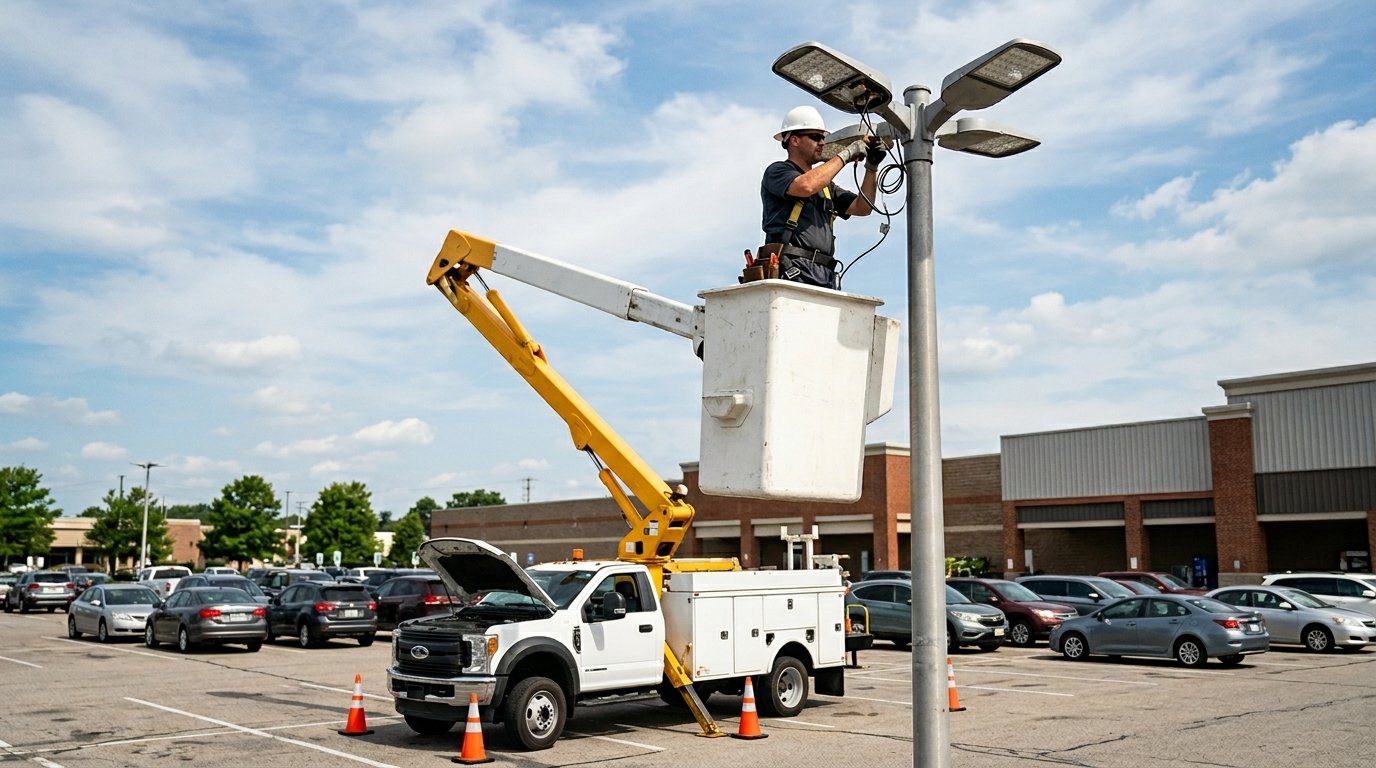
Then we make the repair safely, with the right access. Pole-mounted area lights sit high off the ground, so we use bucket-truck access to reach them safely rather than improvising. We replace failed fixtures, lamps, drivers, and ballasts, repair or replace photocells and controls, address underground feeder faults to a pole, and replace poles that have been knocked down or damaged, restoring the lot to full, even illumination.
Where it makes sense, we recommend converting to LED rather than repeating repairs on aging equipment. We retrofit existing fixtures or replace them with modern LED area lights, often reusing the poles, which brings brighter, more uniform light, far lower energy use, and much less maintenance. For multi-fixture lots, we can also set up a maintenance program so outages are caught and fixed on a schedule rather than only when someone complains.
LED retrofit versus repair, and the liability of a dark lot
At some point, repairing old lot lighting stops making sense. Metal halide and high-pressure sodium fixtures dim and shift color as they age, fail on a recurring basis, and consume far more energy than modern equipment. When a property is paying for frequent relamping and high energy bills, an LED retrofit usually pays back through energy and maintenance savings, while also delivering brighter, whiter, more uniform light that makes the whole property look and feel safer. We can often reuse the existing poles, which keeps the conversion cost-effective.
The liability side is just as important for a commercial property. A dark or partially lit lot increases the risk of trips and falls and security incidents, and it can put a property owner or manager at a disadvantage if an incident leads to a claim. Many leases and local requirements also expect lots to be adequately lit. Keeping the lighting working is not just about appearance, it is about managing real risk.
We help property managers weigh repair against retrofit honestly, based on the age and condition of the equipment and the ongoing costs. Sometimes a targeted repair is exactly right, and sometimes a retrofit is the smarter long-term move. Either way, the priority is a lot that is reliably and adequately lit.
Commercial lot lighting service
Every High Power lot lighting job is diagnosed, repaired safely, and aimed at reliable, even light.
- Systematic diagnosis of fixture, control, or feeder
- Bucket-truck access to high pole-mounted fixtures
- Fixture, lamp, driver, and ballast replacement
- Photocell and lighting control repair
- Underground feeder fault repair to poles
- Knocked-down or damaged pole replacement
- LED retrofit and fixture conversion
- Restoration of even, full lot illumination
- Maintenance program options for the property
- Clear reporting of what was found and done
Patching versus professional lighting service
Lot lighting is a safety system, and guesswork leaves it dark. Here is the honest comparison.
DIY or unlicensed
- Relamping a fixture that has a feeder fault
- Unsafe attempts to reach high pole fixtures
- Repeated repairs on worn-out HID equipment
- A photocell left stuck, wasting power or going dark
- Dark zones that raise liability
- No record of what was repaired
Licensed electrician
- Diagnosis that finds the real cause
- Bucket-truck access for safe high work
- LED retrofit when repair no longer makes sense
- Controls repaired so lighting runs on schedule
- Even, full illumination restored
- Clear reporting for the property file
What affects the cost of lot lighting service
Pricing depends on the scope and access, not a flat fee. These are the main factors.
Number of fixtures
More fixtures or poles to service increases the scope.
Repair or retrofit
A targeted repair differs from a full LED conversion of the lot.
Pole height and access
Tall poles requiring bucket-truck access affect labor.
Underground feeder work
Locating and repairing a buried feeder fault adds to the job.
Pole or fixture replacement
Replacing a knocked-down pole or fixtures is more than a lamp swap.
Controls
Photocell or control repair and upgrades are part of some jobs.
These are general planning ranges for the Dallas area, not a quote. Every job is different, so we give you a free on-site assessment and an honest written price before any work starts.
Our lot lighting service process
From the first call to a fully lit lot, here is how we handle it.
Assess the lot
We survey the lighting and identify outages and problem areas.
Diagnose the cause
We test to find whether it is fixtures, controls, or feeders.
Clear quote
You get a written price for repair or retrofit before we proceed.
Safe access
We bring bucket-truck access to reach high pole fixtures safely.
Repair or retrofit
We repair the fault or convert fixtures to efficient LED.
Restore the lot
We confirm even, full illumination across the property.
Report and maintain
We report what was done and can set up ongoing maintenance.
How long it takes and what to expect
Many lot lighting repairs are handled in a single visit once the cause is diagnosed, especially fixture, lamp, and control issues. Underground feeder faults take longer because they must be located, and a full LED retrofit of a large lot is a planned project. We give property managers a clear scope and timeline, and we can schedule work to limit disruption to the business.
Because lot lighting is a safety system, we prioritize getting dark areas lit again promptly. When the work is complete, the lot is evenly illuminated, the controls run the lighting on the right schedule, and we provide reporting for the property file. For properties that want it, a maintenance program keeps the whole lot reliably lit going forward.
Commercial lot lighting across Dallas
Dallas is full of commercial properties with significant parking, from retail centers and office parks to apartment communities, warehouses, and mixed-use developments. All of them depend on reliable lot lighting for safety, security, and curb appeal, and all of them eventually face outages, aging fixtures, and rising energy costs that need professional attention.
The scale of these lots is what makes professional service essential. Tall poles require bucket-truck access to reach safely, large lots have underground feeders running to multiple poles, and a single control or feeder issue can darken an entire section. Diagnosing and servicing all of that safely is well beyond a quick lamp swap.
The Texas climate and the economics both push properties toward LED. Heat and storms are hard on outdoor fixtures and the wiring feeding them, and the energy and maintenance savings of converting aging metal halide or sodium lighting to LED are compelling for property managers watching operating costs. We help weigh repair against retrofit for each property.
Because we service commercial lots throughout the metro, we know how to diagnose lot-wide outages, work safely at height, repair underground feeders, and deliver LED retrofits that lower costs. The goal is a property that stays safely and reliably lit with fewer surprises.
The licensed Dallas team homeowners trust
Licensed pros
Texas TECL #38291 electricians for commercial lighting.
Bucket-truck access
Safe service of tall pole-mounted fixtures.
Clear quotes
Honest pricing for repair or retrofit before we proceed.
Maintenance options
Programs that keep the whole lot reliably lit.
Parking lot lighting FAQs
It could be burned-out fixtures, a stuck photocell, a tripped breaker, or an underground feeder fault to a pole. When a whole bank is out together, it usually points to a feeder or control issue rather than individual lamps. We diagnose the cause rather than just swapping lamps.
That is typically a failed photocell or lighting control. The photocell is supposed to turn the lights off at daylight and on at dusk, and when it sticks, the lights run all day or fail to come on at night. We repair or replace the control so the lighting runs on the right schedule.
Yes. We use bucket-truck access to safely reach high pole-mounted area fixtures, which is essential for servicing commercial lots. Reaching them safely is part of why this is professional work rather than a ladder job.
It depends on the age and condition of the equipment and your ongoing costs. If you are paying for frequent relamping and high energy bills on old metal halide or sodium fixtures, an LED retrofit often pays back through energy and maintenance savings. We help you weigh it honestly.
LED area lighting uses far less energy, lasts much longer with less maintenance, and provides brighter, whiter, more uniform light that makes a property look and feel safer. We can often reuse the existing poles, which keeps the conversion cost-effective.
It can be. A dark or partially lit lot increases the risk of trips, falls, and security incidents, and many leases and local requirements expect lots to be adequately lit. Keeping the lighting working helps manage real risk for a property owner or manager.
Yes. A pole hit by a vehicle or storm is a hazard, and we replace damaged poles and fixtures and restore the lighting, including any underground feeder repair the impact may have caused.
Yes. When a pole or bank of lights goes dark from a buried feeder fault, we locate and repair the underground wiring feeding it, restoring power to the fixtures.
Yes. For properties that want it, we set up scheduled maintenance so outages are caught and repaired on a routine basis rather than only when someone reports a dark area. It keeps the whole lot reliably lit.
Because lot lighting is a safety system, we prioritize getting dark areas lit again promptly. Many repairs are handled in a single visit once diagnosed, and we schedule larger retrofits and feeder repairs as planned projects.
Yes. We can schedule work to limit disruption to your operations and customers, including coordinating timing that works for the property. We keep managers informed throughout.
Yes. We report what was found and repaired, which is useful for property files and for tracking the condition of the lighting over time, especially under a maintenance program.