Commercial Electrical Outfitting in Dallas
Need commercial electrical outfitting in Dallas, TX (75247)? High Power Electrical Services handles turnkey commercial wiring, lighting, power distribution, and equipment circuits for build-outs and tenant improvements, on schedule, to commercial code, with minimal disruption to your business.
Quick Answer
Commercial electrical outfitting is the complete electrical scope for a business space: power distribution, lighting, dedicated equipment circuits, panels, and the code requirements that come with commercial occupancy. Whether you are opening a new location, building out a tenant space, or remodeling, we deliver it on schedule, to code, and around your operations.
Turnkey electrical for your commercial space
Outfitting a commercial space is a different undertaking from residential work. The loads are larger, the code requirements are broader, the timeline is tied to a business opening or a lease, and the work has to coordinate with a general contractor and other trades. Getting the electrical right, and on schedule, is often what determines whether a space opens on time, which is why experienced commercial electricians matter.
We handle the full electrical scope. That means power distribution and panels sized to the space, lighting designed for the use and the code, dedicated circuits for the equipment a business runs, from kitchen and medical equipment to machinery and server rooms, and the commercial safety requirements like egress and emergency lighting. We rough in, trim out, coordinate inspections, and deliver a space that is ready to operate.
Commercial power also frequently means three-phase service, which efficiently runs the motors, HVAC, and equipment that commercial spaces depend on. We work with single and three-phase systems, size services and subpanels for current and future loads, and make sure the distribution supports the business not just on day one but as it grows.
Just as important is how we work. Commercial projects run on schedules and budgets, and occupied spaces cannot simply lose power for days. We coordinate closely with general contractors, property managers, and owners, plan the work to minimize downtime, and keep the project moving so you can open or reopen on time.
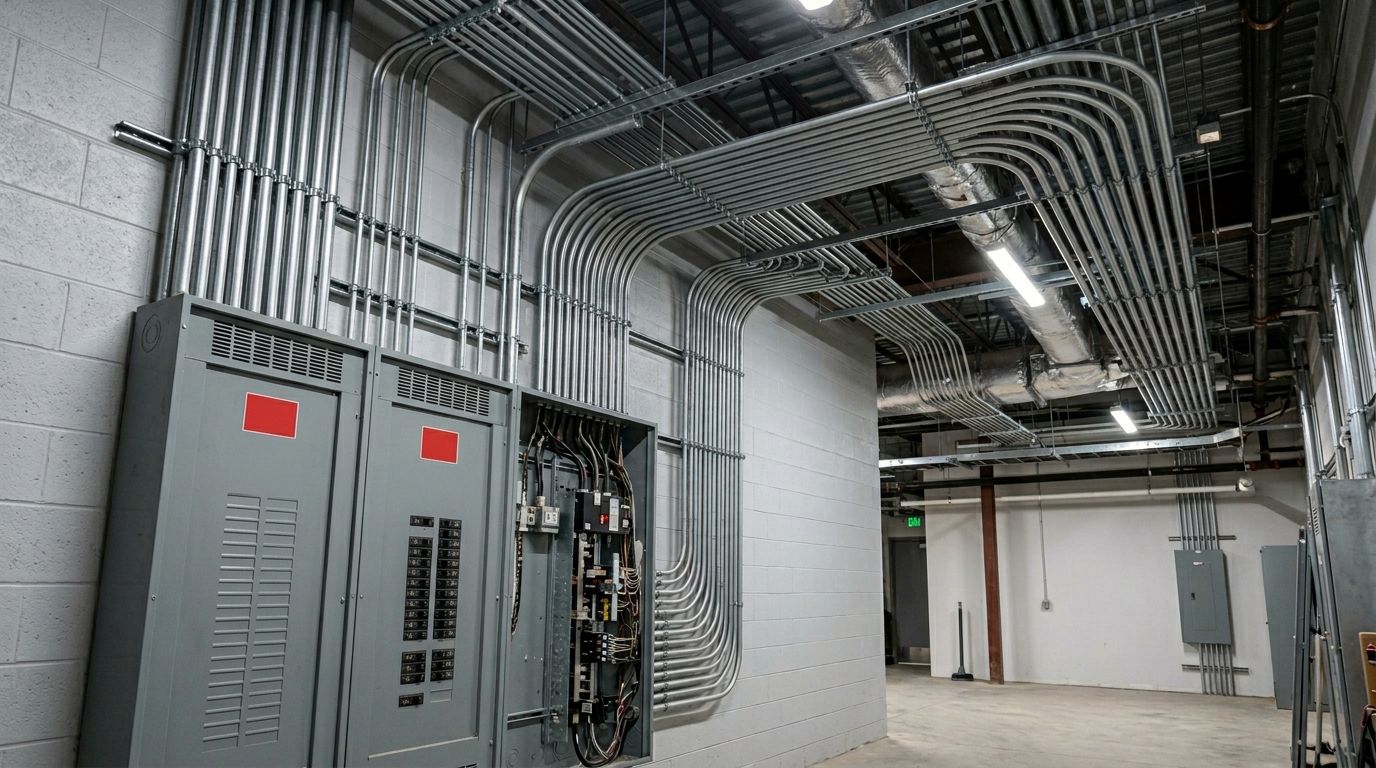
Commercial spaces need power and lighting sized and distributed for the use.
When you need commercial outfitting
If your business faces any of these, a commercial electrical partner is the right call.
Opening or relocating
A new or relocated business needs its space fully wired, lit, and powered to open.
Tenant build-out
A tenant improvement or build-out needs electrical designed and installed for the new use.
Remodeling a space
Renovating a commercial space usually means reworking power, lighting, and circuits.
Adding equipment or load
New equipment, machinery, or HVAC may exceed what the existing service supports.
Changing use or occupancy
A change of use brings new code requirements the electrical must meet.
Outdated electrical
Aging or undersized commercial electrical can limit operations and fail inspection.
Why a commercial electrical partner matters
Commercial work rewards experience, coordination, and reliability. Here is what you gain.
Turnkey scope
Power, lighting, circuits, and code handled as one package.
Commercial code
Egress, emergency lighting, and occupancy requirements met.
On schedule
Work planned to keep your opening or reopening on track.
Scalable power
Service and panels sized for current and future loads.
GC coordination
We work cleanly with contractors, owners, and other trades.
Equipment circuits
Dedicated, correctly sized circuits for your equipment.
Minimal downtime
Occupied spaces kept operating wherever possible.
Licensed and insured
Professional commercial electricians, fully covered.
Building out or opening a commercial space?
We deliver turnkey commercial electrical on schedule. Get a free assessment and a clear quote.
(469) 327-8678How commercial outfitting actually works
We start with the scope and the loads. Working from your plans, your use of the space, and the equipment you will run, we calculate the electrical demand and design the service, panels, and distribution to support it with room to grow. For many commercial spaces this includes three-phase power for motors and HVAC, dedicated circuits for specific equipment, and a lighting design that meets both the needs of the business and the commercial code.
Then we execute in the right sequence. We pull the permits, rough in the conduit, wiring, and boxes in coordination with the general contractor and other trades, set panels and distribution, and run the dedicated circuits your equipment requires. Commercial code adds layers residential does not, including egress and emergency lighting and exit signage, which we build in rather than scramble to add at inspection.
Finally we trim out, test, and turn it over. We install fixtures, devices, and equipment connections, verify every circuit, and coordinate the inspections required for occupancy. Throughout, we keep the project on schedule and communicate with owners and contractors, because in commercial work a missed electrical milestone can hold up the whole opening. The result is a space that is fully powered, code-compliant, and ready to operate.
Commercial versus residential, and working around operations
Commercial electrical differs from residential in ways that matter for planning and budget. The loads are larger and often three-phase, the code requirements extend to egress lighting, emergency systems, and occupancy rules, the inspections are more involved, and the work has to coordinate with a general contractor and a fixed opening schedule. Equipment circuits for commercial kitchens, medical and dental gear, machinery, and server rooms each have specific requirements that have to be designed in, not improvised.
Downtime is the other defining factor. A home can tolerate power being off for a stretch, but a business loses revenue every hour it cannot operate. When we work in an occupied or operating space, we plan the sequence to keep as much running as possible, schedule disruptive work for off-hours where it makes sense, and communicate clearly so there are no surprises. Minimizing downtime is part of the job, not an afterthought.
We also build for the future. Commercial tenants change, equipment grows, and businesses scale, so we size services and panels with headroom and lay out distribution that can expand. Designing in that flexibility up front is far cheaper than reworking a service later, and it is part of delivering a space that serves the business for the long run.
Commercial electrical outfitting
Every High Power commercial project is delivered turnkey, to code, and on schedule.
- Load calculation and electrical design for the space
- Service and panel sizing for current and future loads
- Single and three-phase power distribution
- Dedicated circuits for commercial equipment
- Commercial lighting designed for use and code
- Egress, emergency lighting, and exit signage
- Coordination with the general contractor and trades
- Permits and required inspections handled
- Work sequenced to minimize business downtime
- Testing and turnover ready for occupancy
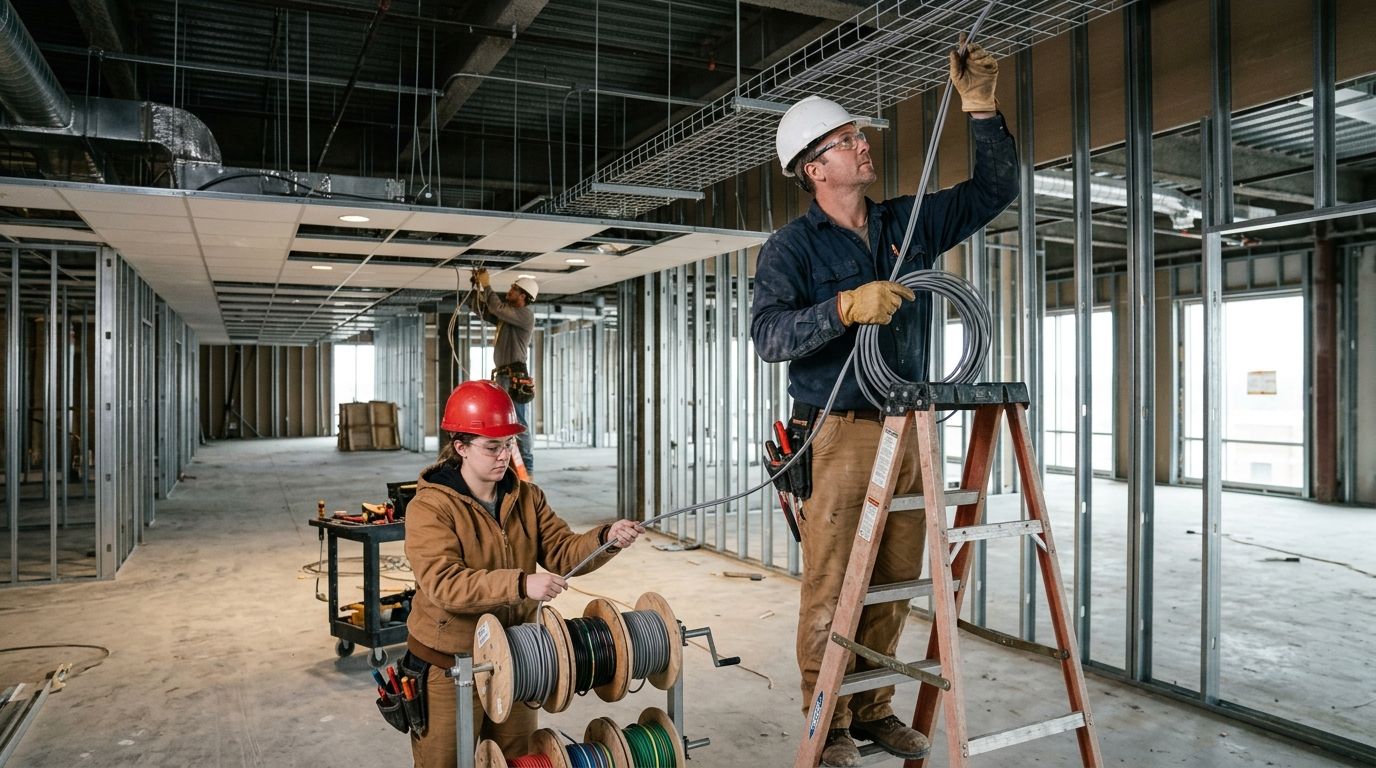
Cutting corners versus a licensed commercial install
In commercial work, shortcuts surface at inspection and in downtime. Here is the honest comparison.
DIY or unlicensed
- Undersized service that limits the business
- Equipment circuits sized by guess
- Missing egress or emergency lighting
- Unpermitted work that fails occupancy inspection
- No coordination with the GC, delaying the opening
- Disruptive work with no plan for downtime
Licensed electrician
- Service and panels sized with room to grow
- Equipment circuits designed to spec
- Egress and emergency systems built in
- Permitted, inspected, occupancy-ready work
- Tight coordination that protects the schedule
- Work sequenced to keep the business running
What affects the cost of commercial outfitting
Pricing depends on the space and the scope, not a flat fee. These are the main factors.
Size and scope
Square footage and the extent of the build-out drive the overall scale.
Power requirements
Three-phase service and high loads need larger services and distribution.
Equipment circuits
The number and type of dedicated equipment circuits add to the work.
Lighting package
The lighting design and fixture count vary widely by use and space.
Service capacity
Upgrading the service or adding panels is a larger part of some projects.
Permits and inspections
Commercial permits and the inspections for occupancy are part of compliant work.
These are general planning ranges for the Dallas area, not a quote. Every job is different, so we give you a free on-site assessment and an honest written price before any work starts.
Our commercial outfitting process
From the first walkthrough to a space ready to open, here is how we handle it.
Assess and plan
We review your plans, use, and equipment to scope the electrical.
Design the system
We design service, distribution, circuits, and lighting to code.
Clear quote
You get a detailed written proposal aligned to your schedule and budget.
Permits and coordination
We pull permits and coordinate with the GC and other trades.
Rough-in
We install conduit, wiring, boxes, and panels in the right sequence.
Trim and connect
We set fixtures, devices, equipment connections, and safety lighting.
Test and turn over
We test, pass inspection, and hand over a space ready to operate.
How long it takes and what to expect
Commercial timelines vary widely with the size and complexity of the space, from a focused tenant improvement to a full build-out, and they are usually tied to the overall construction schedule and the opening date. We plan our work to hit the electrical milestones the project depends on and coordinate closely with the general contractor so we are neither holding up other trades nor being held up.
For work in an occupied space, we sequence around your operations and schedule disruptive tasks to limit downtime. We keep owners and managers informed at each stage, because in commercial work predictability is as valuable as the work itself. When we turn the space over, it is fully powered, code-compliant, inspected, and ready for business.
Commercial electrical across Dallas
Dallas is a busy commercial market, with retail, office, restaurant, medical, and light-industrial spaces constantly being built out, remodeled, and re-tenanted across the metro and its business corridors. That steady activity means a lot of tenant improvements and fit-outs, each needing electrical designed for a specific use and delivered on a schedule.
The variety of commercial properties shapes the work. A restaurant has heavy kitchen equipment loads and specific circuits, a medical or dental office has its own equipment and code considerations, a warehouse needs robust power and high-bay lighting, and an office or retail space prioritizes flexible power and quality lighting. We tailor the electrical to the use rather than applying a one-size approach.
Schedules and code drive commercial work here as everywhere. Opening dates, lease commitments, and occupancy inspections all hinge on the electrical being done correctly and on time, and the commercial code adds requirements like egress and emergency lighting that have to be built in from the start. Coordinating all of it with general contractors is part of how we keep projects moving.
Because we do commercial outfitting throughout the metro, we know the local permitting and inspection process, how to coordinate with the trades on a build-out, and how to deliver a space that opens on time and runs reliably. The goal is electrical that supports your business from day one and scales as it grows.
The licensed Dallas team homeowners trust
Licensed pros
Texas TECL #38291 electricians experienced in commercial work.
Clear proposals
Detailed written scope and pricing aligned to your schedule.
Code-first
Commercial code, egress, and occupancy requirements met.
On schedule
We coordinate with the GC to protect your opening date.
Commercial outfitting FAQs
It is the complete electrical scope for a commercial space: power distribution and panels, lighting designed for the use and code, dedicated circuits for equipment, and commercial safety requirements like egress and emergency lighting. We handle it turnkey, from design through permits, installation, and inspection.
Yes. Tenant build-outs and improvements are a core part of what we do. We design and install the electrical for the new use, coordinate with the general contractor, and deliver the space ready for occupancy on the project schedule.
Yes. Many commercial spaces use three-phase power to efficiently run motors, HVAC, and equipment. We work with single and three-phase systems and size services and distribution for your current and future loads.
We plan the work sequence to keep as much of the space running as possible, schedule disruptive tasks for off-hours where it makes sense, and communicate clearly so there are no surprises. Minimizing downtime is part of how we approach commercial work.
Yes. Commercial projects run on coordination, and we work closely with general contractors, property managers, and other trades to hit the electrical milestones the project depends on, so the build stays on schedule.
Yes. Commercial code includes requirements residential does not, such as egress lighting, emergency systems, and exit signage, along with occupancy rules. We build those in from the start and handle the inspections required for occupancy.
Yes. We calculate the loads for your equipment, from kitchen and medical gear to machinery and server rooms, and design dedicated circuits and adequate service to support them safely and to code.
That comes up often when a space changes use or adds load. We assess the existing service and, where needed, upgrade it or add distribution so the electrical supports the business. We identify this early so it does not surprise you mid-project.
Yes. We design and install commercial lighting suited to the space and use, balancing quality, efficiency, and code requirements, including the emergency and egress lighting commercial occupancy requires.
It depends on the size and complexity and is usually tied to the overall construction schedule and opening date. We plan to hit the electrical milestones the project needs and give you a realistic timeline as part of the proposal.
Yes. We pull the commercial permits and coordinate the inspections required for occupancy, so the work is documented, compliant, and ready to pass.
Yes. We provide a detailed written proposal with the scope and pricing aligned to your schedule and budget, so you know exactly what is included before the project begins.